 Back to Nova Southeastern University


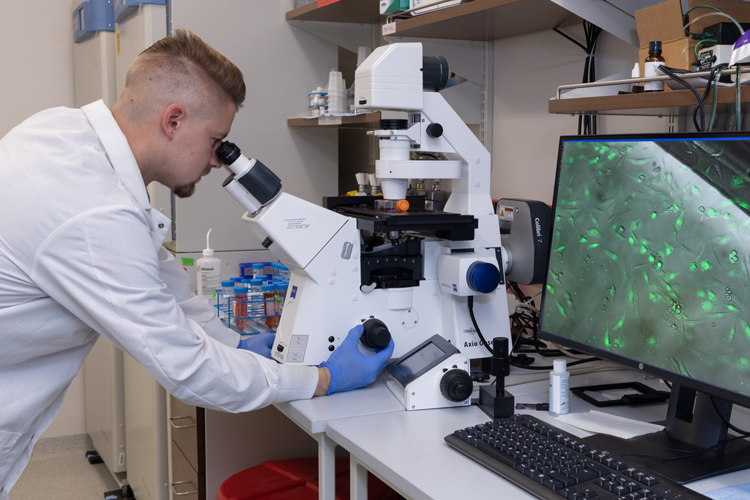
Shape the future of medicine with a Doctor of Philosophy (Ph.D.) in Pharmaceutical Sciences from Nova Southeastern University's Barry and Judy Silverman College of Pharmacy.
This Ph.D. program offers you the opportunity to tailor your academic career with three specialized areas of expertise to choose from:
- Molecular Medicine and Pharmacogenomics, centering on mechanism of action of drugs.
- Pharmaceutics, focusing on effective drug delivery to the desired target.
- Pharmacoeconomics and Outcomes Research, concerned with evaluating the value and real-world impact of drug therapy.
Our curriculum ensures a dynamic and complex exploration of the value and real-world impact of drug therapy, drug knowledge expansion, and technology-driven dosage form development. Become adept in pharmacology, pharmaceutics, pharmacokinetics, or pharmacoeconomics and outcomes research under our expert team's guidance.
Quick Facts





Learn More About Doctoral Program Admissions
Curriculum
The courses are representative of the overall requirements of the program at the time of publication, and are subject to change. The curriculum is revised, as needed, to meet the demands of the profession.
This sequence emphasizes laboratory research and the development of research skills integral to elucidation of the mechanism of action of drugs, as well as the extent and characteristics of those actions.
Students who pursue this sequence will be primarily under the tutelage of faculty members in the Department of Pharmaceutical Sciences, a group of researchers with expertise in pharmacology, medicinal chemistry, toxicology, neuroscience, and biochemistry. Particular areas of expertise include cardiovascular pharmacology, molecular pharmacology, central nervous system diseases, and cancer pharmacology.
Course Name
Credits
Total
100
*Course may be repeated.
#Additional years may be required to complete the dissertation research. The curriculum
for subsequent years is identical to the fourth year (maximum seven years allowed
for Ph.D. completion).
+This course is only available to students in their final semester.
This sequence emphasizes the development of laboratory research skills. Supporting coursework consists of content integral to the theory and practice associated with the incorporation of drug entities into the forms and formulations to achieve efficient drug delivery to the site of biological and medical action.
Students who pursue this track will be primarily under the tutelage of faculty members in the Department of Pharmaceutical Sciences, a group of researchers with expertise in pharmaceutics-related disciplines. Particular areas of expertise include a variety of drug formulations such as abuse-resistant formulations, novel drug delivery approaches, and molecularly targeted drug delivery systems.
Course Name
Credits
Total
97
*Course may be repeated.
#Additional years may be required to complete the dissertation research. The curriculum
for subsequent years is identical to the fourth year (maximum seven years allowed
for Ph.D. completion).
+This course is only available to students in their final semester.
This sequence focuses on coursework and research skills that address the dynamics and complex nature of drug use and distribution systems.
Students that pursue this sequence are advised and mentored by faculty members from the Department of Sociobehavioral and Administrative Pharmacy, a group of scholars whose specialties include among others, pharmacoeconomics and outcomes research, the economics of pharmacy, pharmacoepidemiology, data analytics, health disparities and special populations, cultural competency, patients’ decision making, public policy, social and behavioral pharmacy, biostatistics, and pharmacy administration.
Course Name
Credits
Total
95
*Course may be repeated.
#Additional years may be required to complete the dissertation research. The curriculum
for subsequent years is identical to the fourth year (maximum seven years allowed
for Ph.D. completion).
+This course is only available to students in their final semester.
Graduation from the Ph.D. program requires the preparation and successful defense of a dissertation.
The Ph.D. program is consistent with the criteria for accreditation set by the Southern Association of Colleges and Schools Commission on Colleges (SACSCOC).